Showing posts with label film-related articles. Show all posts

04 January 2012

A Breakthrough for Sherlock Holmes Fans Everywhere

It is pretty safe to say that Sherlock Holmes is universally acknowledged as one of the best characters of all time. He's smart, interesting, witty, and, best of all, uniquely Sherlock Holmes. Sir Arthur Conan Doyle invented him, having been inspired by his former university professor Joseph Bell, who was, apparently, a very intelligent, logical, and perceptive individual. Doyle first unleashed his iconic hunting-cap-and-pipe-donning sleuth to the world in 1884 through A Study in Scarlet, the first of four novels about the character. Doyle's writings of Sherlock also included fifty-six short stories, most of which were published in the British magazine The Strand from 1891 to 1904. Many writers have since used this beloved "consulting detective" as a reference point when writing sleuths into their novels; films have also borrowed Sherlock's likable traits in order to improve bland characters.

Oh Mr. Doyle.

Unfortunately, filmmakers have also attempted to bring Sherlock Holmes himself to life through the power of film. One can only thank them, I guess, for trying. However, in most cases, these attempts have only managed to madden fans (this one included!) and confuse/annoy average viewers. Oh, and they always make Sherlock insufferable and Watson completely unsympathetic.

Oh look, it's that one guy who dies in Star Wars Episode IV!

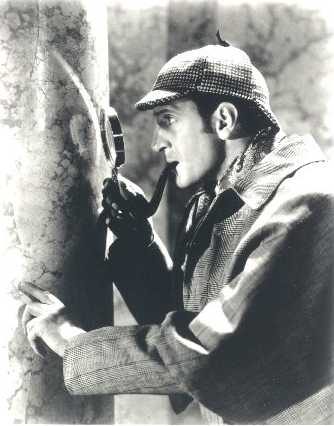
Of course, Basil Rathbone at least looked the part, and Peter Cushing at least tried to be witty and likable, but, in the end, Doyle's stories shined too bright and the failed attempts of filmmakers dulled too dim. Until...

GOD BLESS AMERICA!

... Guy Ritchie found Robert Downey Jr. and Jude Law and said, "Let's make Sherlock Holmes right this time!" And that they certainly did! The first film they came out with in 2009 was funny, exciting, insightful, creative, interesting, and had an appropriate, steampunk feel. I loved it. Being a huge fan of Sherlock Holmes and having read all the stories and novels as a child, I was ecstactic. FINALLY! A film that kept Sherlock's characteristics and Watson's likability! Though freedoms were exercised, they were forgivable, or, in the least, they worked well with the new setting or the characters or simply the story woven around them (a story which, I will add, had nothing whatsoever to do with Doyle). And then, because Hollywood hates us, this happened:

But... why?!

... They made a sequel. Though it was painfully hilarious and had its moments of creativity (even remnants of the original success of the first movie), Sherlock Holmes 2: A Game of Shadows was overall a cinematic rape of the Sherlock Holmes we know and love. There were hardly any moments where Sherlock even bothered using his perception and reasoning skills to solve his problems. Instead, a good hard punch to the face of his opponant or a pointless series of gay innuendo was considered much more effective and entirely what the audience paid admission to see. Indeed, Ritchie must have read fanfiction or something equally horrendous, as every moment was an opportunity to portray Holmes as secretly gay for Watson, or, if that failed, to start up a perfectly avoidable and/or pointless action sequence. Holmes basically went about his problems as intelligently as Arnold Schwartzeneggar does in his movies; which is about as intelligent as a blasted machine gun in the hands of an infant! Though I enjoyed the film for its humour, soundtrack, and Robert Downey Jr., I was sadly disappointed by the sheer lack of effort they put into making it a proper Sherlock Holmes movie. In its place was a hilariously depressing mockery of my favorite sleuth, and the film left me with the fear that my beloved Sherlock would never recieve the cinematic respect he deserves.

But wait! The BBC still exists, right?

GOD SAVE THE QUEEN!

Oh yes, my darlings, it certainly does! This 3-episode show aired in 2010 on BBC 2, and has  become my new husband (sorry, Thor). After dicovering it (mercifully) only a week after seeing Guy Ritchie's abomination, I made it a priority to find and watch. When, at last, my awesome friends got a hold of it and showed it to me, I was hooked like a cod to a fisherman's pole.

Oh yes. This 21st Century adaptation of Sir Arthur Conan Doyle's Sherlock Holmes has so few flaws that I dare say it has NONE AT ALL. Benedict Cumberbatch, a bloke I've seen in many films playing minor, jerkish roles, is the most natural choice for a modern day Sherlock than I could ever have imagined. Martin Freeman, Bilbo Baggins in the up-and-coming Hobbit film, is even more naturally a modern Watson. They maintain the mannerisms, the relationships, the integrity... everything.

Yeah... no one will grieve the hunting cap.

Each episode of this God-given show is a blessed hour and a half long, containing classic plot-points adapted to modern day, and countless in-jokes and subtle references to the original material. They live on 221b Baker Street, they have a Mrs. Hudson, Watson admires Holmes and thinks he's the coolest (like he should --they never seem to include that bit in other films), Sherlock plays the violin and "does drugs," and... well, the list could continue on and on because there are that many praise-worthy attributes for this show. In short, then, I'll say that it has been the first show to ever capture Holmes as he is supposed to be --minus his original setting-- and is therefore one of the most succussful visual adaptations of a book series that I have ever seen. Even Peter Jackson's Lord of the Rings isn't as admirably accurate to the original material!

I mean, there's artistic license and then there's Looney Toons.

In addition, the whole "modern setting" element makes this show all the more charming. For instance, Watson carries on a blog about his and Holmes' adventures, rather than a series of books. Sherlock has his own website describing himself as a "consulting detective," which is a super clever way to let the audience in on his character without the obvious medium of dialogue. Watson is a veteran of Afghanistan, rather than the Second Anglo-Afghan war. The first episode is "A Study in Pink," mirroring the first novel, "A Study on Scarlet." Seriously, this show does not leave fans of Doyle's books disappointed!

That's right, Jude... YOURS was the disappointment!

And with that, all I have left to do is recommend that you watch this show straight away! Netflix has it. The Internet has it. HMV has it. And your library has it, if it's as cool as mine.

So, Happy Viewing, fellow Sherlock Holmes enthusiasts! If you're like me, this show will resurrect your faith in good filmmaking --or, at least, where your favorite iconic detective is concerned.


Sherlock, BBC 2 - created by Mark Gatiss & Steve Moffat - Season 1 aired 2010; Season 2 released Jan 1, 2012

09 December 2011

I love Alan Rickman.

Need I say more?

If he isn't hatin' on Harry Potter as the Potions master of Hogwarts, than he's hatin' on Robin Hood as the Sheriff of Nottingham. If that's not enough hatin', than he hates on our beloved John McLane as a German terrorist, or on Sweeney Todd as a daughter-stealing Judge. Basically, he is every excellent movie-villain ever.

A surprisingly common characteristic found in standard Good vs. Evil films, is the attempt to keep the villain somewhat likable --or, to use more "industry-relevant" terms, they try to "keep the villain human." This means that filmmakers don't want audiences hating the villain too much, because this can make the film seem too dark, too unpleasant, or too fake. An example of this working well can be seen in the original Star Wars trilogy, through the iconic villain Darth Vader. Sure, he was "evil," but once you get to The Return of the Jedi you discover his "good side" - or, the side of him that remained human - and he becomes a more sympathetic and likable character. This device is often found in books, too, and I think it's one of the cleverest traits an author/filmmaker can include in their villainous characters. Often, the films (and books) I enjoy the most include evil-but-likable (human) villains. And, if I were to write you a list of these villains, you would find several Alan Rickman characters close to the top.

 C'mon, you can't tell me you didn't cry during the Deathly Hallows.

Movie-wise, there are few things more effective than a well-performed villain. Sometimes, an actor can redeem an originally bland or terribly-written character through the power of a good performance. This is one of Alan Rickman's keenest talents. Recently, I got around to watching Rickman's cult-status, villainous performance opposite the forgettable/bland/annoying Kevin Costner in Robin Hood: Prince of Thieves. This film is tiresome, long, and annoying, but Rickman's hilarious performance as the wicked Sheriff of Nottingham was hugely enjoyable and nearly redeemed the extra-bland performance Costner gave as Robin Hood. (This is a snatch of this delightfully over-the-top performance, for your viewing pleasure.)

Seriously, when a villain declares, "...and call-off Christmas!" as the concluding factor in his evil scheme, you know you've found yourself an epic villain. And he could only have been played by Alan Rickman.

Also, I just might have a thing for scary dudes in beards.

Rickman's first big-time film role was as the terrorist-villain Hans Gruber in the first Die Hard film, opposite action-star Bruce Willis. To this day, Hans Gruber is considered to be one of the greatest villains of film history; not to mention one of the downright best villains ever. I can tell you honestly that Rickman - not the screenwriter! - made that happen.

The main trouble with action-movie villains is that they are often boring, typical, and downright hatable. With Rickman's Hans Gruber, this is not the case. Though you egg Bruce Willis's character on through the entire film, you still watch Rickman carry out his evilness with equal enjoyment. As a result, Die Hard is one of the best films of this genre that I have ever seen.

*As a sidenote, I will add that Die Hard, being set during Christmas Eve, is also my favorite Christmas movie of all time, and I've forced my family to watch it every year since first seeing it. My father enjoys this tradition, but mum and Lana prefer It's A Wonderful Life, hands down.

Who isn't overcome with Christmas cheer when they look into that face?

Surprisingly, Rickman has also seen his share of romantic, standard, and black comedies; lust-thrillers, parodies, and even musicals (most famously as the corrupt judge in Tim Burton's Sweeny Todd). In fact, it can be deduced upon examining Rickman's various performances that he really isn't a serious guy. Almost every role he's played has some kind of comedic or soft-hearted edge, making whatever character he plays much more interesting and agreeable.

Yep.

However, I must conclude by saying that his best role by far has been as Severus Snape. As often as this has already been said, he was just too perfect for it. In fact, Alan Rickman was J. K. Rowling's personal choice to portray her "favorite character;" and she even let him in on spoilers concerning Snape's character very early on in the Harry Potter films. So basically, Alan Rickman is probably the only person on earth to have found out about Snape-spoilers so early; and frankly, he's the only person on that same earth to have deserved such a priveledge. Apparantly, even Rowling thought so, too.

In the end, then, we have discovered two things: 1) Alan Rickman is epic, and 2) Laura found this fact worthy enough to base an entire Cracked-style blog post around it. All she can say, is that she hopes you enjoyed the post, and that you will come to further enjoy the subject matter himself.

Best. Pout. Ever.

Recommended Alan Rickman films:
2011 - Harry Potter and the Deathly Hallows Part II 
2008 - Bottle Shock  
2007 - Sweeny Todd: The Demon Barber of Fleet Street
1999 - Galaxy Quest
1995 - Sense and Sensibility
1991 - Robin Hood: Prince of Thieves  
1988 - Die Hard

06 July 2011

Indiana Jones and the Temple of Doom

When I say that I once had a crush on Harrison Ford, I mean I HAD A CRUSH ON HARRISON FORD. Accompanying my exposure to the wonders of the original Star Wars trilogy at the age of 9, was the rugged and sarcastic Han Solo, and my first inklings of my own womanhood.

But I won't get into that.
Now that I have related this background information, I feel less awful in admitting that at one time -brace yourself- I actually liked the Indiana Jones movies. Now, don't get me wrong: Raiders of the Lost Ark, the first of the series, was rather good; a cutting-edge in action/adventure films at the time. Suddenly, leading men could be invincible [concussions and brain damage as a result of repeated punches to the skull? So yesterday, dude] and could do the most death-defying stunts and spout the wittiest one-liners while somehow remaining down-to-earth and personable. Steven Spielberg, the series' director, became the No. 1 action director of the 80's. However, after the success of that very entertaining film came a long line of insufferable sequels with no substance -or even shame- to be found in them. Entertaining perhaps, but in a way that makes you feel 12 years old and tasteless once the credits roll.

The Temple of Doom was the first of these epic-lame sequels.

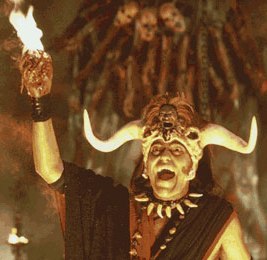
Something about this poster makes me like the film even less.
After the huge success of Raiders in 1981, The Temple of Doom was an understandably huge box office hit when it came out three years later. The film grossed almost 34 million dollars nation-wide in America during its opening weekend in theaters - this is 22 million more than when Raiders was released! I'm sure that, at the time, those who paid part of those millions to see it thought that it was satisfactory "as far as sequels go" [kind of like the Harry Potter movies]. My dad related to me that he liked it back then, though he now admits [after joining me in my re-watch and analysis] that it's pretty bad. If it wasn't for the extreme nostalgic value of the film, I personally would have heartlessly added it to my "Worst Films Ever" list. Though many people view this as a "classic" just because it's an Indiana Jones movie, I'm afraid I really don't agree.

...annoying.
I think that the main elements of this film which make it so agonizingly annoying are the leading lady [played by a pretty but extremely unlikable Kate Capshaw] who found it necessary to scream over every little thing and have no personality whatsoever; the very stunted and you-can-tell-it-was-written-for-them dialogue [complete with terrible sexual innuendo]; the weird, shallow and lame-as-hell plot; and the random and overly long sequences of ridiculous action which go so far they exceed even "so bad it's good" territory. Ugh.

*facepalm*
Unlike Raiders, which did all those things right [the very likable female lead Karen Allen; interesting plot and character development; fun and exciting action sequences; and engaging and funny dialogue] Indiana Jones and the Temple of Doom loses you in its desperate attempt to entertain you. It's hokeyness almost felt on purpose at times, with weirdly arranged jokes or puns and occasionally silly acting. Capshaw even made fourth-wall contact with the audience at one point!

Need I say more?
In the end, it's the kind of film you watch because it's bad, because you can't get enough of Indy and his perposterous shenanigans, or not at all because you'd rather be baking a cake or putting together a bookshelf or watching Ricky Gervais' stand-up or riding a bicycle. I recommend any or all of those to watching this gigantic pile of Spielberg-scum.

4/10 "lame as hell"

24 June 2011

The King's Speech

Occasionally in my film-watching, I will stumble across a film which absolutely takes me off guard with its superior acting/cinematography/writing/etc. Usually, I only find a handful of these in a whole year, scattered among the mediocre and/or good films that fill the rest of the time. Don't get me wrong: I see a LOT of very good films in a year. I simply don't see extremely great films all that often. However, in the first 4 months of this year, I had already seen three knock-out motion pictures: Alfred Hitchcock's Psycho, the German art thriller Run Lola Run, and then the AFI listed Bonnie & Clyde. That, usually, would have filled my quota of remarkable movies for the year, but then this movie happened.


At long last, I got around to seeing The King's Speech. I had expected it to be quite good, not so much because it won Best Picture [remember: there are very few really great Oscar winning films!] but because of the heart behind it. However, even if I had expected it to be as great as it is, my expectations would have still been blown away.

Screenwriter David Seidler first began work on The King's Speech in the 1970's. Being deeply interested in King George VI, and wanting to tell his story as authentically as possible, he contacted the still-living speech therapist Lionel Logue [played by Geoffry Rush, one of my favorite actors ever, in the film] who eagerly shared his memories and old notes with him. However, before such a screenplay could be made into a film, a written consent from Queen Elizabeth was required. She said that she would prefer it to be made after her death. Therefore, the project was abandoned in 1982. After the queen died in 20 years later, it still took until he had throat cancer in 2005 before he had the inspiration to pick up the script again.


Thank God he did! Seidler won a well-deserved BAFTA and Oscar for Best Original Screenplay. Awards are the most valuable when presented to such worthy nominees as David Seidler, who waited almost 40 years to get his movie made! They couldn't have been given to anyone else. But as far as well-deserved awards go, I thought that Tom Hooper did an excellent job of directing Seidler's story and that he totally deserved his Oscar as well.

Not to mention Colin Firth: the renowned British romantic comedy actor who I thought was great in Bridget Jones's Diary, but would never have imagined for such a role as the stuttering King George VI. But Lord, the guy can act! I thought that he also very much deserved his Oscar, if only for surprising us with his sudden capabilities as a serious, interesting actor.


So that is the story of The King's Speech, folks, in all of its impressive glory. Very few films these days have the quality that this one does: the depth of the story, the believable acting, and the imaginative and engaging directing. If you haven't already seen it, find a copy and watch it with Twinnings tea and dark chocolate. You will not be disappointed.

Rating: 10/10 "masterpiece"

31 March 2011

Bonnie & Clyde are totally boss.


Adorable, right?
This movie is so great.

"The strangest damned gang you ever heard of. They're young. They're in love. They rob banks." –tagline

Warren Beatty and Faye Dunaway are fantastic as the legendary bank robbing lovers Clyde Barrow and Bonnie Parker. Their smash-hit chemistry (beating other famous couples like Edward & Bella all to hell) is only bested by their likability –or, perhaps, how attractive they are. I am honestly not embarrassed to say that I find them amazingly charming, even considering their felonious career as bank robbers.
Bonnie & Clyde, Arthur Penn’s greatest film, was released in 1967, and rivaled such classics as The Graduate and In the Heat of the Night at the Oscars (the latter being the winner.) Much like Dustin Hoffman in The Graduate, this was Faye Dunaway’s first real role, and Warren Beatty’s first great role (or, at least, the first that didn’t involve him as a “spoiled, popular, rich kid with girl problems,” of which he has a considerable list).
Now, as somewhat-romanticized as this film was, I truly felt that Penn captured certain realistic elements that the Barrow Gang probably -and certainly- went through during their career in bank robbing.

It was believable that Bonnie would leave her home, her mamma and her “life” to go with the bold and adventurous Clyde, since the blandness of her job and tiresome nature of her hometown were well expressed. It captured the immature interest in each other that they were famous for, which quickly turned into a passion great enough to withstand the looming threat of life in prison. It portrayed the nit-picky arguments between themselves and the later members of the Gang to an almost painful extent, but certainly with good reason. It showed the boldness, rashness, and almost delusion which kept them robbing, and how unprofessional they were.

Most importantly, Penn didn't go out of his way to make the viewer feel things for the characters, or sympathize too much. You certainly do, but I felt he kept close enough to the reality of the situation as to remind you that these people truly weren't very nice.

Alongside the talented Beatty and gorgeous Dunaway, Gene Hackman, Estelle Parsons, and Michael J. Pollard make up the Barrow Gang.

After Bonnie and Clyde partner up and begin their bank-robbing career together, they realize that they need a driver and some extra help. Enter Clyde’s brother, his wife, and the young C.W. Moss. Now, you need to realize that Bonnie and Clyde are the kind of characters that you secretly hope will make it, despite their actions and how obvious it is that they won’t. So, when these other people get involved and things start to get complicated, the film becomes a nightmare of hidden stress on their behalf. 
Outwardly, of course, you make sure that your law-abiding fellow viewers know that you’re on the “good side” by making comments about the debauchery of bank robbing and unmarried sex, even though you know they're thinking the same thing as you!

That, folks, is a real woman.

I don’t know much about the real-life couple, but I know enough to know that I like them a lot, despite their selfishness in the way of money-making during the Depression. Much like John Dillinger, another bank-robber at large during the Depression [see Public Enemies, starring Johnny Depp], you find yourself feeling confusingly sad and hopeful that these criminals will make it. Of course, this could be due to Hollywood’s passion for making vigilantes and criminals as likable as possible (they usually succeed, as even Hannibal Lector is one of most likable characters I’ve ever seen) but even after doing a little research and looking through old footage and photographs, you know damn well that even the real life people may be difficult not to like.

Clyde is a badass. Look at that gun!
In the end, then, Bonnie & Clyde is a film for the ages. It makes you feel guilty, charmed, sad, impressed, annoyed, pleased, stressed, interested, hopeful, excited, and regretful, all at once. The acting is brilliant all round, the scenes are well cut, the story moves smoothly, and if you’ll ever like “bad” characters in your life, you’ll certainly like these ones.
Truly, this is a film worth watching.

Faye Dunaway and Warren Beatty
Bonnie Parker and Clyde Barrow